My research group develops ground-breaking theoretical and computational frameworks that resolve long-standing problems. Each framework is a collection of methods and theoretical models that work together synergistically. Each framework functions as a sort of ‘scientific infrastructure’ that provides utility to other scientists and engineers by unifying diverse concepts and properties. A key goal is to educate the next generation of scientists and engineers to learn how to use these new theoretical tools.
This serves the United States’ (U.S.) national interest by: (i) exploring and advancing the scientific frontier, (ii) making the U.S. more competitive through technological and scientific advances, and (iii) making the U.S. more competitive by teaching the next generation of scientists and engineers how to use these new theoretical tools.
Together with my research group, I am developing the following theoretical and computational frameworks:
Space mixing theory
I’m creating a new theoretical framework called space mixing theory. The goal is to model the fundamental structure of physical spacetime, to unify physical interactions, and to describe the origins of subatomic particle properties. Earlier in my career, I did a lot of exploratory unpublished research on this topic. A key goal and challenge is to refine and publish this theory in the near future.
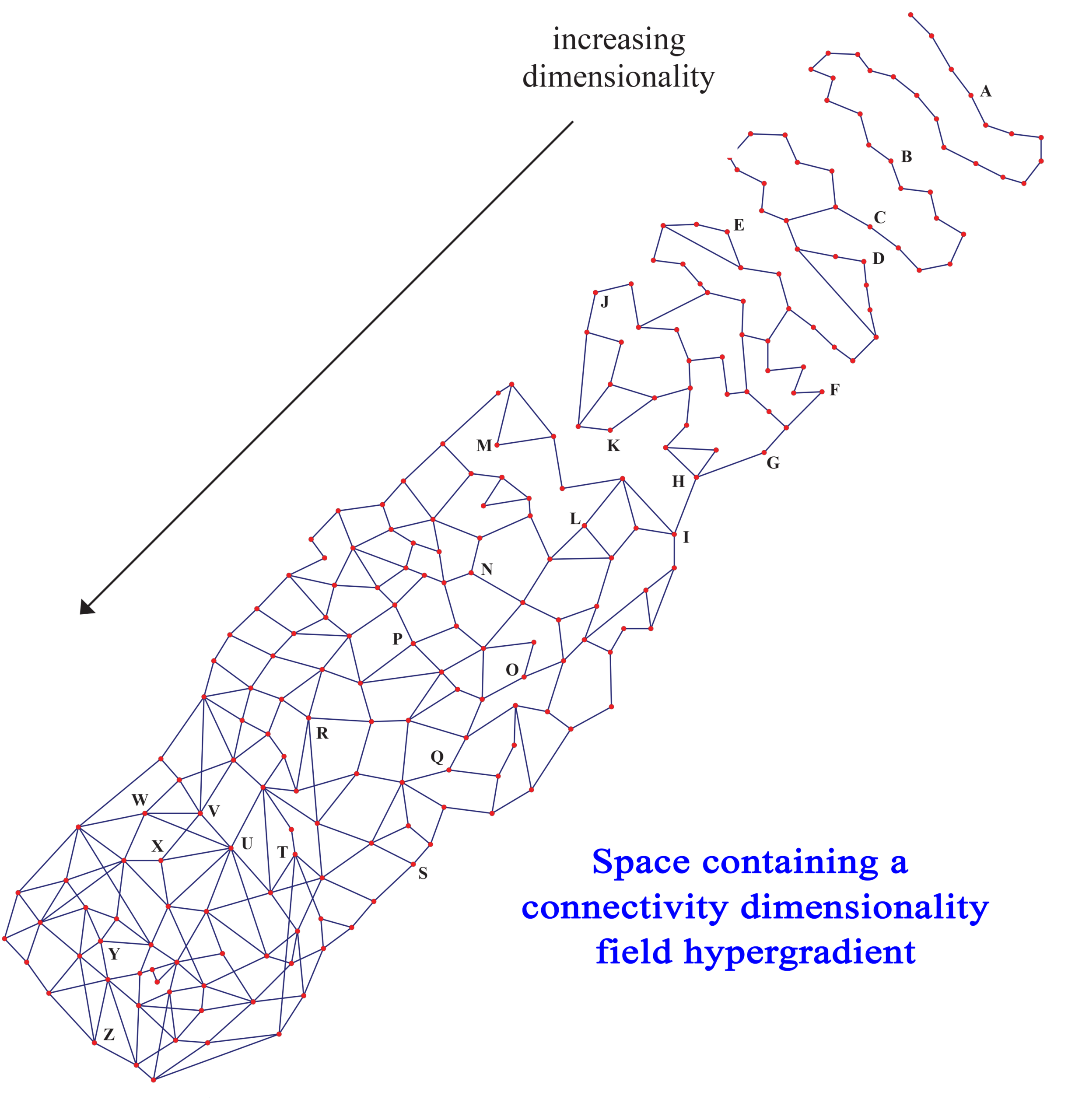
Standard atoms in materials framework (SAMF)
Many quantitative descriptors (such as bond orders and electron configurations) of atoms in materials have a long history in the chemical sciences but remained poorly defined for decades. Some approaches were well-defined but suffered key limitations. This created a confusing hodgepodge of techniques that lacked unification and widespread applicability. Richard Bader pioneered the development of the quantum theory of atoms in molecules (QTAIM) as a unified approach to assigning atom-in-material properties. QTAIM atoms are formed by partitioning a material’s electron density distribution into non-overlapping compartments. On the other hand, I’m creating the standard atoms in materials framework (SAMF) as a unified approach to assigning atom-in-material properties based on overlapping atoms. The SAMF partitions a material’s electron density distribution into atoms with overlapping electron density distributions using stockholder-type partitioning. Hirshfeld developed the first stockholder partitioning approach, but it was too primitive. The SAMF goes far beyond stockholder-type partitioning by assigning electron configurations, spdfg subshell populations, atomic orbitals in materials, bond order components, projected density of states plots, etc.
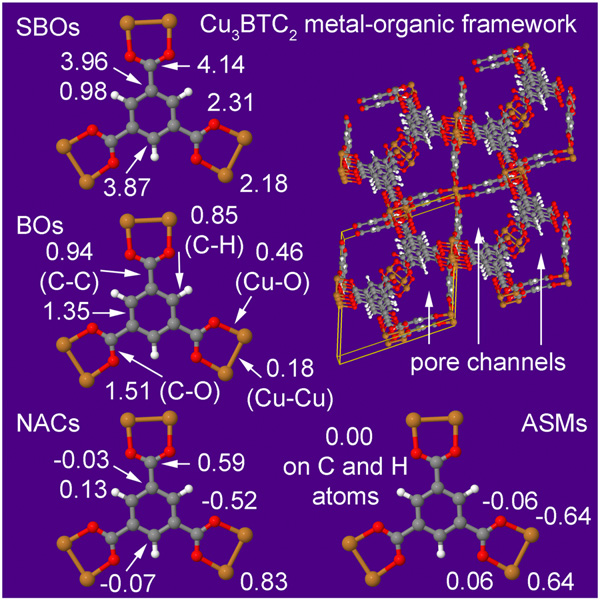
The SAMF is being developed to contain six main parts:
- Reference ion and core density libraries
- Density-derived atom-in-material (AIM) properties computed using Density-Derived Electrostatic and Chemical (DDEC) methods: net atomic charges, atomic spin moments, bond orders, AIM radial moments, etc.
- Non-reactive forcefield functional theory to parameterize polarizable, flexible forcefields including methods to compute: bond stretch parameters, angle bend parameters, dihedral torsion parameters, Lennard-Jones parameters, AIM polarizabilities, AIM dispersion coefficients, quantum Drude oscillator parameters, etc.
- AIM properties derived from the first-order density matrix or orbital projections such as: AIM electron configurations, spdfg subshell populations, atomic orbitals in materials (AOIMs), bond order components, bond order symmetries, subshell population redistribution principles, projected density of states plots, etc.
- Applications to crystal structure curation, such as identifying misbonded atoms and/or improving the fidelity of the crystal structure refinement.
- Electron-nuclear motion separation schemes is the sixth part and involves both established approaches (such as the Born-Oppenheimer separation and the harmonic oscillator approximation) as well as a new approach that I’m developing that is not yet published.
Superdeterminants and electron-electron correlations
I’m using superdeterminants to: (a) approximately compute matrix permanents via Monte Carlo sampling and (b) model electron-electron correlations in chemical systems. Superdeterminants provide powerful advantages by allowing many configurations to be simultaneously sampled.